Health & Safety Policy — Hedge Trimming Wembley
 Hedge Trimming Wembley provides professional hedge care and maintenance services across its service area. This policy sets out our commitment to protect the health, safety and welfare of employees, contractors, clients and the public during all hedge maintenance, pruning and hedge-cutting activities. The purpose of this document is to define clear responsibilities, safe systems of work and practical controls that reduce risk from common hazards associated with hedge work, including working at height, using powered equipment and operating near boundaries or traffic. We describe expectations for training, equipment, communication and ongoing monitoring so that every job involving hedge trimming in Wembley is planned and executed safely.
Policy Statement
We are committed to a proactive approach to health and safety. All staff will be provided with the information, instruction and supervision necessary to carry out tasks safely. Our objectives include preventing accidents and work-related ill health, reducing environmental impact and ensuring that operations are conducted with respect for client property. The company will allocate sufficient resources for safe plant, effective PPE and training. Managers and supervisors must ensure compliance with this policy at every site, while individual operatives are required to follow safe systems and report hazards promptly.Scope and Responsibilities
 This policy applies to all hedge maintenance work including residential and commercial contracts, one-off hedge-cutting and ongoing contract maintenance. Responsibilities are defined as: company leadership sets policy and provides resources; supervisors plan and monitor tasks; operatives perform work safely and use equipment correctly; clients and site occupants should cooperate to reduce risks where practical. Contractors working on our behalf must meet our standards and provide evidence of competence. Clear role definitions ensure accountability for risk assessments, permits for work at height and supervision.
Risk Assessment and Safe Systems
Every job starts with a site-specific risk assessment and method statement. Key risks include falling from ladders or platforms, cuts from edged tools, noise, vibration, fuel hazards, falling debris and contact with hidden services or wildlife. Work plans will consider access, ground stability, overhead obstacles and nearby traffic. Control measures include segregation of the work area, use of appropriate access equipment, exclusion zones, and weather-based postponement when conditions are unsafe. Records of risk assessments are retained for review and continuous improvement.
PPE, Tools and Equipment
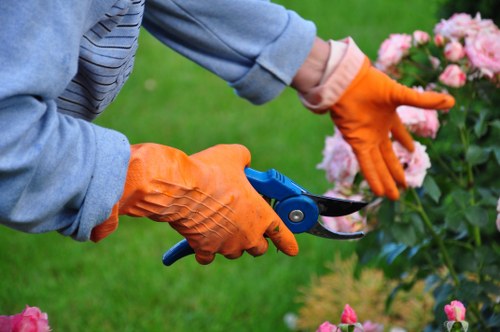
Operatives are supplied with and required to wear suitable PPE for hedge work. This includes eye protection, hearing protection, gloves, chainsaw-resistant trousers where appropriate, and high-visibility clothing. All powered equipment, from hedge trimmers to powered saws, is inspected before use and maintained in line with manufacturer guidance. Batteries and fuel are handled safely and stored securely to prevent spills or ignition. Equipment selection considers the scale of the job — hand tools for fine shaping, petrol or electric trimmers for larger hedges — and ensures the right tool for the task.Standard Equipment and PPE List
- Helmet with face shield and ear protection
- Cut-resistant gloves and trousers
- High-visibility jacket and sturdy boots
- First aid kit and mobile communication device
Training, Competency and Supervision
Training is essential to safe hedge maintenance. Staff receive induction training, task-specific instruction and periodic refresher sessions. Competency assessments cover tool handling, working at height, manual handling and ecological awareness. Supervisors ensure inexperienced operatives are supported and that complex tasks are only undertaken by trained personnel. Apprenticeship or formal qualifications are encouraged for staff performing advanced hedge-trimming or tree-pruning duties. Training records are maintained and reviewed as part of our safety management process.Emergency Procedures and Incident Reporting
First aid arrangements are provided on site in proportion to the task risk. In the event of an incident, operatives must secure the scene, provide first aid and summon medical assistance when required. All incidents, near misses and hazards are reported and recorded for investigation. The findings are used to update risk assessments and prevent recurrence. Communication protocols include notifying supervisors and documenting incidents in the company log.Environmental and Site Protection
Waste management and environmental protection are integral to our safety approach. Cuttings are contained, removed or mulched in a controlled manner to avoid obstruction of public footpaths or drains. Care is taken to protect client property, boundary features and planted areas. Wildlife checks are conducted to avoid disturbance. Traffic management measures are deployed when work is near roads, including signage and, where necessary, banksmen to direct vehicles and pedestrians.